Book Mark

Ike.ninja

Linux Fun
  • Home
  • How to
  • Reference Links
  • Categories
    • Releases
    • Plesk
    • Community
    • CMS
    • security
    • MYSQL
    • cPanel
  • Tools
    • IP Checker
    • Byte Converter
RSS

Steam phishing attacks exploiting look-alike domain names

Jun25
by Ike on June 25, 2014 at 12:58 pm
Posted In: security

An ongoing series of phishing attacks against the Steam gaming community is making effective use of look-alike domains to trick users into surrendering their usernames and passwords. The fraudsters behind these attacks then attempt to bypass Steam’s two-factor authentication with a malicious executable that is deceptively named SteamGuard.exe.


One of the many look-alike domains involved in the attacks against steamcommunity.com

Victims are being targeted through Steam’s own chat client, giving fraudsters the opportunity to
spear phish accounts which are known to contain valuable tradable items. Since the inception of
Steam Trading
, it has become easier to monetize stolen accounts by selling
the victim’s virtual items to other Steam users.
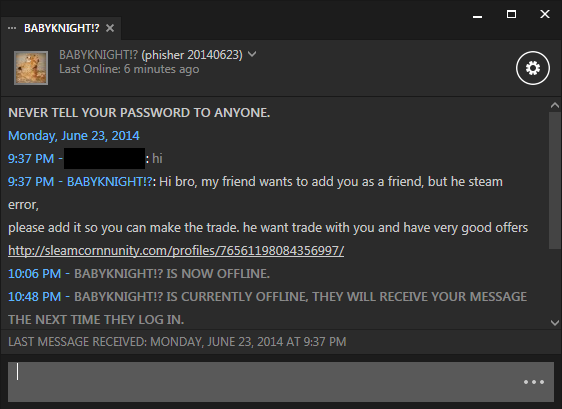

Fraudsters are using Steam’s own chat client to lure victims to phishing sites.
These sites use deceptive domain names, designed to look similar to the real steamcommunity.com.

If a targeted Steam user is persuaded to click on one of these links, he will be taken to a fake Steam profile. The following example shows another of these fake profiles on a similar look-alike domain. Profiles used in these attacks may appear to offer rare or unusual tradable items, and the high level and displayed XP score lends some degree of trustworthiness to potential trades.


The fake profile offers some attractive items up for trade.

To further entice the victim into trading with the fraudster, the fake profile also includes fabricated feedback which enhances the fraudster’s reputation as a fast and reliable trader.

However, the fraudster is not intending to trade any items with his victim — he instead wants to gain access to the victim’s account, and then steal the victim’s own tradable items. When the victim clicks on the “Add Friend” button, he will be presented with a spoofed login form on the look-alike domain that requests his Steam username and password:
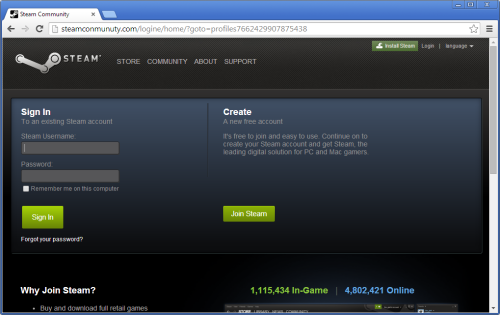
The stolen username and password will not be of much use to the fraudster if the victim has enabled

Steam Guard
. This two-factor authentication mechanism is enabled by default if the victim has a verified email address and has restarted Steam at least twice since verifying the address. If Steam Guard is enabled, the fraudster will be unable to access his victim’s Steam account without entering an access code which is emailed only to the victim.

Bypassing Steam’s two-factor authentication (Steam Guard)

Older Steam phishing sites simply asked the victim for their access code, but this approach is no longer suitable for trade fraudsters: there is now a time-delay before the trading feature can be used from a new device, which gives the victim an opportunity to recover his compromised account before any items can be traded by the fraudster.

Steam phishing sites consequently evolved to ask their victims to upload a special

ssfn
file. This file is located in the victim’s Steam folder and acts as an authentication key, so that after providing a valid access code, the user does not have to keep on requesting and entering a new access code every time they launch Steam. If this file is copied to the fraudster’s computer, he will be able to bypass the two-factor authentication mechanism and gain access to the victim’s account.

The Steam phishing sites used in these latest attacks have evolved further still. Rather than tricking the victim into uploading the ssfn file, the phishing sites now display the following dialog box which prompts the victim to install a “special tool”:

Unsurprisingly, this special tool is actually malware designed to find and upload the victim’s ssfn file to the fraudster. The SteamGuard.exe file used in this particular attack is hosted on Google Drive, and submits the victim’s ssfn file to a hard-coded URL on the phishing site it was originally downloaded from.

After the fraudster has been furnished with the victim’s username, password and ssfn file, he will be able to login to the account and begin trading immediately.

Constant stream of look-alike domains

Since the start of May, more than a hundred look-alike domains have been registered specifically for the purpose of Steam phishing. More than a third of these phishing sites have been hosted in Russia, and many of the domains have also been registered to individuals with Russian addresses and email addresses at yandex.ru, a free webmail service.


Some of the 100+ look-alike domain names that have been registered for Steam phishing since May.

Most of the domains used in these attacks have been registered under the .com top-level domain. One notable counterexample is steamcommunity.cm, which uses the country code top-level domain for
Cameroon. As well as being used in spear phishing attacks via Steam’s chat client, it is likely that this particular phishing site could also have also received
typo-traffic from Steam users.

More generally, the .cm ccTLD offers tremendous typosquatting opportunities against any corresponding .com domain. The domain’s operators received criticism

in the past
when it wildcarded the entire .cm domain. It no longer does this, but there is evidently nothing stopping fraudsters from registering a .com domain’s corresponding .cm domain anyway.


Using an “unusual hat” as a lure to visit the steamcommunity.cm phishing site.

Monetizing stolen Steam accounts

Albrecht Neumann, a mathematics student in Germany, is an active Steam trader who has reported some of these phishing attacks to Netcraft. He suspects the fraudsters are automatically searching trading portals for people who are offering to sell expensive items, and are then sending messages to those users via Steam: Each time he “bumps” a thread in which he is offering expensive items, he gets up to five new friend requests.

Neumann told Netcraft that keys and earbuds are a primary target for trade fraudsters, as these items serve as a relatively stable currency in the Steam economy, and are easy to turn into real money. Earbuds are cosmetic items which can be worn by a player’s in-game character, and were given away to Mac OS X users who played Team Fortress 2 during a limited time period in 2010; but now they can only be obtained through trading. Some users stockpile these items in the hope that their value might increase and earn them a profit further down the line. Such items are valuable by virtue of their rarity, and can often be sold for $30-$40 each, making some accounts worth thousands.

All of the domain names used in these attacks were very similar to the real steamcommunity.com domain. Netcraft’s
Fraud Detection service helps brand owners pre-emptively identify these types of fraudulent domain registrations. Some of the domains were registered months before the attacks actually took place, which would have allowed plenty of time to get them shut down before they were misused. Domain registrars are in a position to nip this in the bud even earlier — they can use Netcraft’s
Domain Registration Risk service to prevent their customers from registering domain names which are deceptively similar to well known phishing targets.

└ Tags: code, Domain Registration Risk, password, security, site
 Comment 

Debian: 2966-1: samba: Summary

Jun25
by Ike on June 25, 2014 at 8:24 am
Posted In: Other

(Jun 23) Security Report Summary

 Comment 

Ubuntu: 2232-3: OpenSSL regression

Jun25
by Ike on June 25, 2014 at 7:34 am
Posted In: Other

(Jun 23) USN-2232-1 introduced a regression in OpenSSL.

└ Tags: USN
 Comment 

Ubuntu: 2254-1: PHP vulnerabilities

Jun25
by Ike on June 25, 2014 at 7:34 am
Posted In: Other

(Jun 23) Several security issues were fixed in PHP.

└ Tags: PHP
 Comment 

Deceptive search engine ads used in Bitcoin wallet attacks

Jun24
by Ike on June 24, 2014 at 10:00 am
Posted In: security

Fraudsters are exploiting loopholes in the presentation of ads by major search engines in order to lure victims to phishing sites. Searching for “blockchain”, the name of a popular Bitcoin wallet provider, caused deceptive ads to be displayed at the top of search results pages from Google, Bing, Yahoo, and DuckDuckGo. In contrast to the traditional approach of sending emails indiscriminately, links to phishing sites in search engine ads may be much more convincing, especially when the domain they are impersonating is displayed as the destination.

With more than 1.7 million wallets, Blockchain.info is the most popular online Bitcoin wallet. Blockchain’s My Wallet service allows users to send and receive payments in Bitcoins. When signing up, users are reminded that they must remember their passwords, as forgotten passwords cannot be recovered and will result in the loss of all Bitcoins stored in the wallet. These passwords are exactly what the fraudsters are after.


Phishing ads in Bing’s search engine results. Screenshot taken on 19 June 2014 at 10:16 BST.

The above screenshot shows the results of searching for “blockchain” on Bing. The first link on the page is an ad, supposedly for the official Blockchain wallet service at Blockchain.info. However, clicking on this link actually takes victims to a phishing site under blockchaino.info (note the additional ‘o’ character).


Bing! There go your coins.

The phishing site at blockchaino.info immediately prompts a victim to enter his identifier and password, whereas the real Blockchain website only prompts for the user’s identifier. Blockchain’s security recommendations make it clear that the real Blockchain.info will never ask you for your password: “We NEVER need it and we NEVER want it”. As soon as the fraudster has tricked the victim into giving up the required information, they “sweep the funds away“.

This type of attack is likely to be extremely effective, as the ad displays the same domain name as the site it is targeting, and it is the first link to appear in the search engine results page. Some users may not realise that it is an ad, and instead believe that it is the top organic result. Showing the wrong display URL (green text) is forbidden by most ad networks’ policies; however, the fraudsters have
evidently managed to bypass these restrictions. Without strict enforcement, the ability to specify the displayed destination leaves such advertising open to fraud.

However, strict enforcement of destination URLs may alienate a search engine’s customers — advertisers may use third-party services to manage their advertising and track clicks. These customers will rely on being able to display the final URL despite redirecting via a third-party service before reaching the target site. The use of redirects makes enforcement of any display policy difficult, as there is no guarantee that the target of the redirect will remain constant after the ad has been approved, or that the redirects presented to the search engine are the same as those presented to end users.


Another phishing site advertising at the top of Bing.

Other Bing ads directed victims to different Blockchain phishing sites, all of which used deceptive hostnames such as blockchain-info.itconflux.com, blockchain.info.pl and bllockchain.info.pl, but did not use the display domain of the site they were impersonating, blockchain.info.

It’s not just Bing’s search engine that has been affected by this phishing campaign. The search ads displayed at the top of Bing search results can appear anywhere on the Yahoo Bing Network. This means that the same fraudulent ads also appear when a victim searches for Blockchain on Yahoo.com. Similar phishing ads are also displayed on the DuckDuckGo search engine, which syndicates its sponsored links from the same network.


The same phishing ads appear on a Yahoo search for “blockchain”.

And it is not just the Yahoo Bing ad network which is being exploited by phishers — search giant Google displayed the following phishing ad on its search results pages:


This Google phishing ad directed victims to blockchain-info.itconflux.com.

However, it’s not necessarily game over if a victim’s password has been stolen. If a Blockchain user has chosen to enable two-factor authentication via SMS, Yubikey or Google Authenticator, the fraudster will be unable to access the wallet at a later date unless he also has access to the victim’s physical two factor authentication device (e.g. phone or Yubikey).

All of the sites involved in these attacks against Blockchain were blocked in Netcraft’s phishing site feed, which allows third-party developers to integrate anti-phishing services into their products. Some of the domain names used in these attacks were very similar to the real blockchain.info domain. Netcraft’s Fraud Detection service helps brand owners pre-emptively identify these types of fraudulent domain registrations, giving an opportunity to take action against the registrants, possibly before the attacks have even started.

└ Tags: info, password, security, site, URL
 Comment 
  • Page 2,396 of 2,975
  • « First
  • «
  • 2,394
  • 2,395
  • 2,396
  • 2,397
  • 2,398
  • »
  • Last »

What’s New?

  • Fedora 41: Apptainer CVE-2025-65105 Security Fix Advisory
  • Fedora 43: Apptainer 1.4.5 Important Fix CVE-2025-65105
  • Ubuntu 18.04: USN-7907-5 Linux Kernel Important Security Flaws
  • Debian: Chromium Important DSA-6080-1 Code Exec DoS Issues
  • Fedora 42: SingularityCE Important Upgrade 4.3.5 – FEDORA-2025-54d78b9fed
  • Fedora 43: perl-Alien-Brotli Critical Security DoS Fix 2025-d93200cf16
  • Fedora 42: Wireshark 4.6.1 Critical Issue Advisory – FEDORA-2025-f810869906
  • Fedora 42: yarnpkg Command Injection Fix CVE-2025-64756 Advisory
  • Ubuntu 25.10: Linux Kernel Critical Flaws Security Patch USN-7906-3
  • Ubuntu 22.04: USN-7889-6 Linux Kernel Important Security Patch
  • Ubuntu 22.04 LTS: Linux Kernel Critical Security Issues USN-7928-3
  • Ubuntu 22.04: 7928-2 Linux Kernel FIPS Security Updates
  • Ubuntu 22.04 LTS: USN-7928-1 Linux Kernel Critical Security Issues
  • Debian: Important DoS Vulnerabilities in FFmpeg DSA-6080-1 Advisory
  • Ubuntu 20.04 LTS: USN-7922-1 Linux Kernel Important Security Issues
  • Ubuntu 24.04 LTS: Kernel Important Security Fixes USN-7921-1 CVE-2025-39946
  • Debian: firefox-esr Critical Privilege Escalation DSA-6078-1 CVE-2025-14321
  • 2026 Global Partner Program Announcement
  • Debian: pdns-recursor Critical Denial of Service Vulnerability DSA-6077-1
  • Debian: libpng1.6 Critical Info Leak & DoS Vulnerabilities DSA-6076-1
  • Fedora 43: python3-docs Update 2025-e235793f10 – Maintenance Release
  • Fedora 43: python3.14 Critical Update Addresses Quadratic Complexity Bug
  • Debian: WordPress Important XSS and Info Disclosure DSA-6075-1
  • Ubuntu 22.04 LTS: fontTools Important Path Traversal Risk CVE-2025-66034
  • Debian: webkit2gtk Critical Info Exfiltration DSA-6074-1 CVE-2025-13947

Search

Translator

Tags

Business and industry code Community cPanel CVE Debian Debian Linux Distribution - Security Advisories Development Events Fedora Fedora Linux Distribution - Security Advisories General Hosting Important Advisory Linux Moderate Advisory Month in WordPress news Parallels Plesk Parallels Plesk Panel Performance PHP Plesk news and announcements Plesk Panel Podcast ProdDevSec Product and technology Products Project Release News Red Hat Red Hat Linux Distribution - Security Advisories Releases security Security Centre sensitive site Ubuntu Ubuntu Linux Distribution - Security Advisories update updates Various vulnerability Web Server Survey Wordpress wp-briefing

Posts

Helpful Links

  • Liquidweb.com
  • MYSQL Dev Documentation
  • Plugins
  • Source forge SED command
  • Themes
  • WordPress Documentation
  • You Tube
December 2025
M T W T F S S
« Nov    
1234567
891011121314
15161718192021
22232425262728
293031  
  • Google
  • Yahoo
  • Liquid Web
  • Storm
  • YouTube

©1999-2025 Ike.ninja | Powered by WordPress with Easel | Subscribe: RSS | Back to Top ↑

64 queries. 8.75 mb Memory usage. 5.291 seconds.