(Apr 2) An updated thunderbird package that fixes several security issues is now available for Red Hat Enterprise Linux 5 and 6. The Red Hat Security Response Team has rated this update as having [More…]
Comment
(Apr 2) An updated thunderbird package that fixes several security issues is now available for Red Hat Enterprise Linux 5 and 6. The Red Hat Security Response Team has rated this update as having [More…]
(Apr 2) An updated jenkins package that fixes one security issue is now available for Red Hat OpenShift Enterprise 1.1.3. The Red Hat Security Response Team has rated this update as having moderate [More…]
Over the last few months, the Platform team of maintainers and developers have been talking about future directions. One of our goals for this year is to introduce namespacing. This has been a very large undertaking and as work has progressed, it became obvious that backward compatibility was going to be a constant battle. One of the negative side-effects of this would be that the Joomla CMS wouldn’t be able to use the planned 13.1 release of the Platform for some time if we introduced namespacing in that version.
After a lot of discussion both internally and with other developers in the community, in order to address the problem, as well as to take advantage of some new opportunities, we’ve decided to make some changes to the Platform.
Bitcoin, a distributed digital currency that cryptographically verifies transactions, has recently seen a large increase in usage — the total amount of Bitcoins in circulation is now well over $1B US Dollars and each Bitcoin is today worth more than $100. By way of comparison, Gibraltar — a British Overseas Territory and a conventional tax haven — had an economy worth an estimated $1.275B in 2008.
Speculators, investors, and criminals alike have been drawn to the alternative currency in the hopes of exploiting its anonymity, its almost exponential rising exchange rate against conventional currencies, and its dominant position amongst non-governmental currencies. Its attraction to criminals is diverse: it has become the de facto equivalent of cash facilitating anonymous purchases of illegal goods, and the dramatic increase in the value of each Bitcoin has meant that Bitcoin wallets have become increasingly attractive targets for would-be phishers.
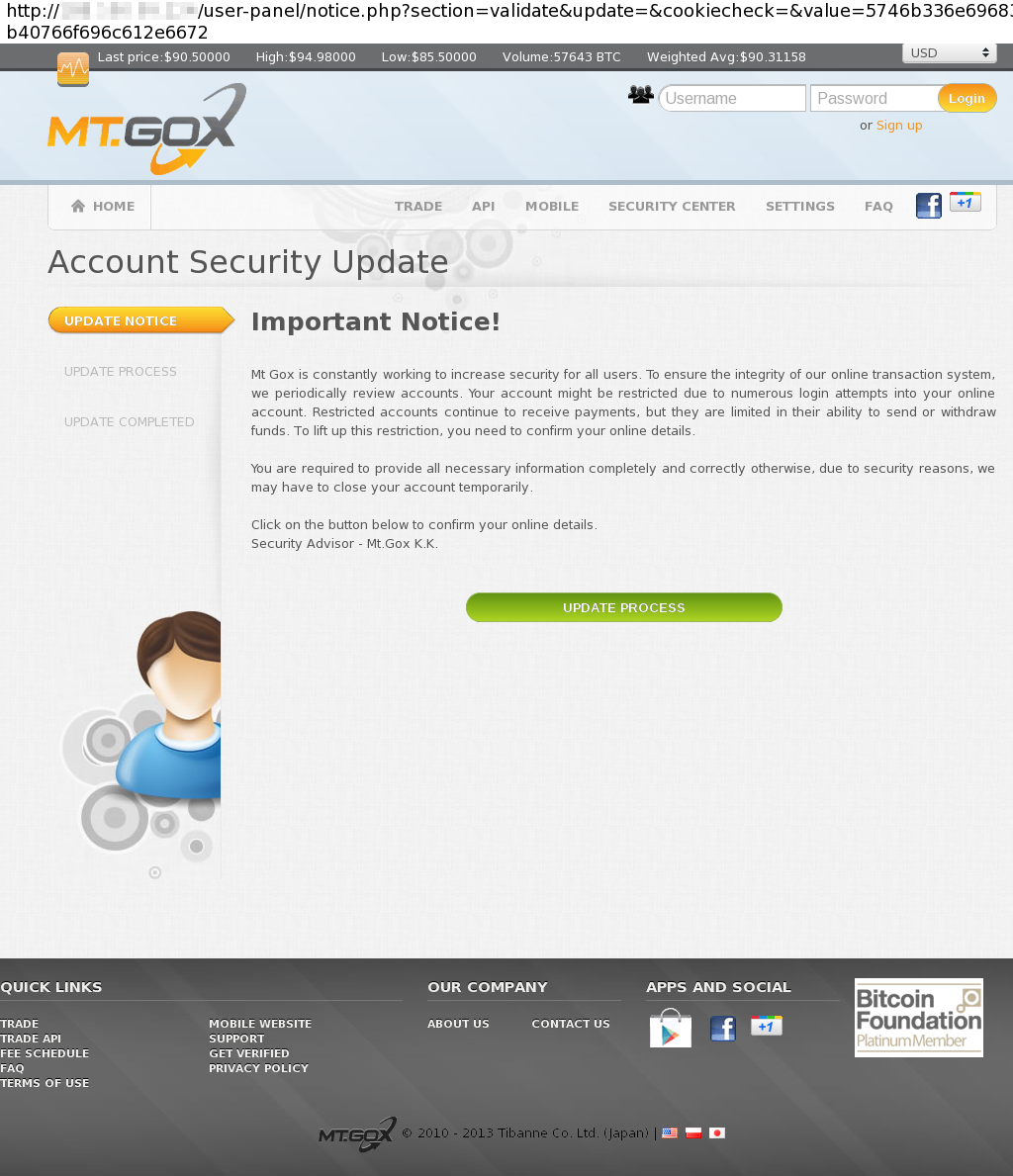
A recent phishing attack against the leading Bitcoin Exchange, Mt. Gox
Bitcoin users are no strangers to being targeted by criminals: last month, attackers were able to steal $12,000 worth of Bitcoins from Bitinstant, a Bitcoin transaction services company, by obtaining the credentials for a brokerage account after socially engineering access to their emails. Malware writers have also targeted Bitcoins: Infostealer.Coinbit is a Trojan horse that tries to steal Bitcoin wallets. Criminals have also been using networks of infected computers to mine Bitcoins for themselves.
Bitcoin exchanges, organisations converting between Bitcoins and conventional currencies, are an obvious target for fraudsters. Last Thursday Mt. Gox (the leading Bitcoin exchange) faced a “stronger than average” DDoS attack. In September 2012 Bitfloor (another Bitcoin exchange) suspended operations after the theft of ~24,000 BTC (worth $250,000 at the time), and the Bitcoin exchange, Bitcoinica, went out of business after also suffering from large thefts.
Despite the apparent risk of operating in this business, some organisations are promoting a laissez-faire attitude to security to the Bitcoin community: BitPay recommends that merchants “[..] can eliminate the need for PCI Compliance and expensive security measures” by replacing credit card transactions with Bitcoin-based solutions.
Netcraft can provide Phishing Site Takedown and Countermeasures services, PCI Approved Vulnerability Scanning and Penetration Testing to Bitcoin exchanges, merchants, and e-commerce sites. For more information, please contact [email protected]. Internet users can be protected against phishing sites, Bitcoin-related or otherwise, by Netcraft’s Anti-Phishing Extension. Help protect the internet community by reporting potential phishing sites to Netcraft by email to [email protected] or at http://toolbar.netcraft.com/report_url.

The April issue of the Joomla Community Magazine is here! Our stories this month:
Listen Up!, by Alice Grevet
Interview with Community Development Manager David Hurley, by John Rampton
Joomla! is the People, by Helvecio da Silva
Interview with CMSExpo Founder John Coonen, by John Rampton
The X Factor and Women in Tech, by Dianne Henning
JoomlaDay Boston, No Blarney!, by Dianne Henning
Leadership Highlights – April 2013, by Marijke Stuivenberg
Progressive Enhancement: Flip the Script on Your Responsive Ways, by Ryan Boog
Tips to Find a Joomla Developer, by Johans Empuerto
Creating Call-to-Actions that Will Actually Get Action, by Hannah Kaufman
Easy To Use Joomla Search Operator Commands, by John Rampton
Head in the Tag Clouds, by Elin Waring
4 Ways Joomla Developers Can Monetize Free Extensions, by Pravin Daryani
Joomla! 3.0 Extension Development Series: More Functionality, by David Hurley
Joomla! 3.1.0 Tag Field, by Roberto Segura
CDNs for Joomla – A Beginners Guide, by Steven Johnson
Community Choice Extensions – UPDATE, by Dianne Henning
Post your Haikus for April, by Dianne Henning
Browse the international articles submitted this month.
We want to publish your Joomla! story in the next JCM issue! So take a look at our Author Resources content to get a better idea of what we are looking for, and then register to become a JCM author and submit your Joomla! story!
51 queries. 8.5 mb Memory usage. 0.367 seconds.